- October 22, 2026
Moving antique furniture from the USA to Romania requires more than arranging a truck and booking ocean space; the wrong packing method, incomplete paperwork, or an unclear quote can put valuable pieces at risk.
Whether you are planning a relocation to Romania, sending inherited furniture to family, or furnishing a historic home, the shipment needs to be assessed as both a delicate object and an international cargo movement.
This guide explains how to decide what is worth shipping, how professional antique moving services protect fragile and valuable pieces, what affects antique furniture shipping costs, and which questions to ask before booking.
You will also learn how to prepare for documentation and destination delivery without relying on assumptions about customs, timing, or the final price.
Moving Antique Furniture to Romania Starts With a Piece-by-Piece Assessment
The safest international furniture move begins before packing. Antique furniture is not a uniform category: a solid oak dining table, a veneered cabinet, a marble-top console, and an upholstered chair can require completely different handling.
A reliable plan is based on the construction, condition, dimensions, value, and travel risk of each item.
Decide What Is Worth Shipping
The first question is not whether a piece can be moved. In most cases, it can. The more useful question is whether the item’s financial, sentimental, or design value justifies the cost and complexity of international transportation.
When moving antique furniture, consider the replacement difficulty, not only the resale price. A family heirloom may have modest market value but be impossible to replace.
Conversely, a large antique that is readily available in Romania may not make financial sense to ship if it requires extensive crating, special handling, storage, and delivery coordination.
A simple decision review should consider:
- The item’s condition and susceptibility to damage during handling
- Its packed size, weight, and shipping volume
- Its insurance or valuation requirements and your ability to document its value
- Whether the piece has cultural, historical, or export-related significance
- The likely cost of professional packing, transportation, destination services, and any applicable charges
Before moving antique furniture, do not make the decision using room dimensions alone. Doorways, staircases, elevators, loading docks, and access roads at both addresses can determine whether a piece must be partially disassembled or moved through a different route.
Document Condition Before Packing
Photographs and written notes are useful for planning and for creating a clear record of the furniture’s condition. Photograph the front, back, sides, legs, hardware, ornamentation, veneer, glass, and existing marks. Capture close-ups of scratches, loose joints, old repairs, stains, fading, and areas of finish loss.
While moving antique furniture, keep any available provenance records, appraisals, purchase documents, restoration invoices, and photographs showing the piece in your home. These records may help establish value and ownership history, although they do not replace any documents that authorities or carriers may require.
The condition record should be completed before movers begin wrapping. If a cabinet has a pre-existing crack, that fact should be understood by everyone involved rather than discovered after delivery. Experienced antique furniture moving companies use the survey to identify weak points and select packing materials accordingly.
Identify Construction Risks
Age alone does not determine fragility. Old furniture can be structurally strong, while a newer restored piece may be more vulnerable because of thin veneer, fresh finish, weakened adhesive, or replacement hardware.
For anyone moving antique furniture, inspect for loose joints, lifting veneer, unstable feet, cracked glass, worm damage, brittle inlays, unfastened moldings, and drawers that may shift in transit. Avoid forcing stuck drawers or applying household repair products before the move.
A well-intended repair can change the surface, conceal a problem, or make professional packing more difficult.
At Earthrelo, the useful planning conversation is item-specific. A clear inventory allows the moving team to distinguish ordinary household furniture from pieces that need custom protection, special crating, controlled handling, or additional coordination.

Tell us about your move and get a personalized quote
based on your requirements.
How Is Antique Furniture Packed for International Shipping?
When moving antique furniture, international transportation exposes furniture to repeated loading, unloading, vibration, changes in temperature and humidity, and long periods inside handling networks. A protective wrap that is adequate for a short local move may not be enough for an overseas shipment.
The packing plan should protect the finish, structure, corners, hardware, and vulnerable decorative details without trapping moisture or creating pressure points.
Use the Right Protection for the Material
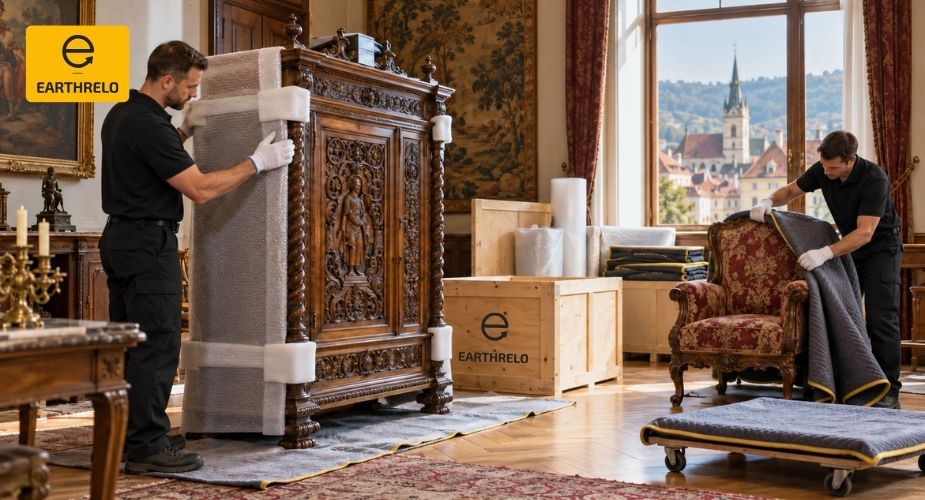
Wooden antiques generally need a layered approach. Movers may use soft, non-abrasive materials against finished surfaces, followed by cushioning and stronger outer protection. Corners, feet, carved details, handles, and projecting elements need special attention because they can catch on equipment or transfer impact into the frame.
Before moving antique furniture, glass doors, mirrors, shelves, and removable panels should be assessed separately. Depending on their design and condition, they may be removed, protected in place, or packed in individual cartons or crates.
Hardware should be labeled and secured so it does not scratch the furniture or become separated from the correct piece.
Upholstered antiques create a different set of concerns. Fabric, leather, horsehair, padding, and wood frames can respond differently to moisture and pressure. Protective materials should not compress delicate upholstery unnecessarily or remain against a sensitive surface for an extended period without the right barrier.
Read also: Hiring Best Antique Furniture Movers While Moving from Italy
When Custom Crating Makes Sense
While moving antique furniture, a crate is not automatically the best choice for every antique. It adds protection, but it also adds weight, volume, labor, and cost.
Custom crating is more likely to be appropriate when a piece is unusually valuable, structurally delicate, irregularly shaped, heavily carved, made with fragile glass, or difficult to secure using standard packing materials.
For anyone moving antique furniture, a proper crate should be designed around the furniture rather than built as a large empty box.
The item needs internal clearance, cushioning that will not abrade the finish, restraints that do not place stress on weak points, and an exterior that can be handled safely. The crate should also be clearly identified and prepared for the intended transport process.
Ask whether the quoted packing service includes standard protection, custom boxing, or custom crating. These terms are not interchangeable, and treating them as interchangeable is one of the common reasons a quote changes after the shipment has been surveyed.
Do Not Wrap Every Surface the Same Way
When moving antique furniture, some finishes can be damaged by adhesive tape, direct contact with rough cardboard, or prolonged contact with unsuitable plastic. Finishes may also react poorly to condensation or restricted airflow.
That does not mean plastic is never used; it means the packing system should be selected by someone who understands the material, finish, climate exposure, and time in transit.
Before moving antique furniture, the same principle applies to disassembly. Removing legs, shelves, doors, or hardware can reduce the packed footprint, but it can also expose weak joints or create reassembly risk. A mover should record what was removed, protect each component, and retain the hardware with the correct item.
A professional packing plan is therefore a balance between protection and restraint. Overpacking can increase costs and handling difficulty, while underpacking can leave a valuable surface exposed. The goal is a stable, inspectable package that can be handled without relying on luck.
Tell us about your move and get a personalized quote
based on your requirements.
What Documents and Costs Should You Confirm Before Shipping?
While moving antique furniture, a quote for antique furniture shipping should describe more than transportation from one address to another. International moves may involve origin services, packing, export preparation, transportation, destination handling, delivery access, unpacking, storage, and other charges that depend on the shipment and the route.
The details must be confirmed before you compare providers.
Build a Complete Cost Picture
For anyone moving antique furniture, the most useful quote separates services so you can see what is included and what depends on conditions at the origin or destination. Request clarification on packing labor, materials, custom crates, pickup, loading, transportation, destination handling, delivery, unpacking, debris removal, storage, and access-related services.
When moving antique furniture, costs may change when the actual shipment differs from the survey. Examples include discovering additional furniture, a higher-than-expected packed volume, a stair carry, restricted building access, a long carry from the truck, a required lift, extra crating, or storage caused by a delivery delay.
These are not necessarily improper charges, but they should be explained rather than appearing for the first time on an invoice.
Before booking, ask:
- Which services are included in the written estimate, and which are excluded or conditional?
- What could cause the price to change after the in-home or virtual survey?
- How are valuation, storage, destination handling, access problems, and special packing treated?
- Who will contact you if the shipment plan changes?
Before moving antique furniture, a lower initial quote is not automatically the better value. If it excludes the packing needed for a fragile cabinet or leaves destination services unclear, the final cost may be harder to control than a more complete quote.
Keep Ownership and Value Records Organized
While moving antique furniture, create an inventory using plain descriptions, photographs, dimensions, and identifying features. “Antique chest” is less useful than a description that notes the material, approximate age if known, number of drawers, finish, hardware, visible condition, and dimensions.
Keep digital copies of the inventory and supporting records in a location separate from the furniture.
Requirements for exporting or importing antiques can depend on the item’s age, origin, material, value, historical importance, and the authorities involved. Rules and documentation expectations can change, and an antique’s appearance alone does not establish how it will be treated.
Confirm the applicable requirements for your specific pieces and route with the appropriate authorities or a qualified customs professional before shipment.
For anyone moving antique furniture, do not assume that a receipt, appraisal, or family history document is sufficient for every purpose. It may support valuation or ownership history without satisfying a particular declaration or clearance requirement.
Understand Protection and Claims Procedures
Ask how the moving company records pre-existing condition, what valuation or protection options are available, and when damage must be reported. Coverage terms vary by provider, shipment, and service agreement.
Some forms of protection may have exclusions or limits for existing damage, inadequate owner packing, fragile components, or particular types of loss.
When moving antique furniture, consider an independent professional appraisal for high-value antiques. An appraisal can support a more realistic valuation discussion, but it does not guarantee reimbursement or eliminate the need to understand the written terms.
Earthrelo can help coordinate the moving services involved in an international household shipment, including packing and specialized handling where appropriate. The practical objective is to make the scope visible before pickup so you can make a comparison based on the complete plan rather than a transportation figure alone.

Have questions about your upcoming move?
Our team is ready to help.
How Should You Plan Pickup and Delivery in Romania?
Before moving antique furniture, the route does not end when the furniture reaches Romania. Destination access, building rules, delivery timing, storage needs, and unpacking responsibilities can affect both risk and cost. These details deserve attention while the shipment is being planned, not after the cargo is already in transit.
Survey Both Addresses
At the U.S. origin, identify the path from each room to the vehicle. Measure narrow doorways, stair turns, hallways, elevators, and any low clearances. Check whether building management requires advance notice, certificates, reserved parking, elevator protection, or a specific delivery window.
While moving antique furniture, at the Romanian destination, assess the same route. A historic apartment, rural property, or older building may have narrow stairs, uneven access, limited parking, or no elevator large enough for a packed cabinet. A modern building may have strict loading hours or require reservations.
Street conditions and seasonal weather can also influence how a delivery is performed.
For anyone moving antique furniture, if the furniture cannot pass through the normal route, alternatives may include partial disassembly, a different entrance, a lift, or delivery through another opening. Each option must be evaluated for feasibility, permission, safety, and cost.
Never wait until delivery day to discover that the item will not fit.
Coordinate Storage Carefully
Storage can be useful when the residence is not ready, the shipment arrives before your move-in date, or restoration work is underway. However, storage introduces another handling cycle and extends the time the furniture remains outside its final environment.
Ask where storage takes place, whether the facility is intended for household goods, how access is managed, whether the furniture remains crated, and how storage charges are calculated. For sensitive antiques, discuss climate and environmental conditions with the provider rather than assuming that every storage facility offers the same protection.
When moving antique furniture, if a piece arrives in a crate, opening it immediately is not always the best choice if the destination is still damp, dusty, unfinished, or unsuitable for installation. The right approach depends on the packing method, the item, the storage environment, and the delivery plan.
Allow Time for Inspection and Placement
Before moving antique furniture, plan to inspect the exterior packaging as soon as the shipment arrives. Photograph damage to crates, cartons, wrapping, or restraints, and compare the contents with the inventory.
If something appears damaged or missing, follow the provider’s reporting process promptly and retain the packing materials until the matter is reviewed.
Antique furniture may need time to adjust to a new indoor environment, particularly when the origin and destination have different temperature or humidity patterns. Avoid placing sensitive pieces immediately beside a radiator, vent, fireplace, or direct sunlight.
Do not restore, refinish, tighten, or discard packing materials before you have completed the inspection and understood any claim requirements.
While moving antique furniture, professional delivery may include placement or unpacking, but the exact scope varies. Confirm whether the team will remove crates, assemble furniture, position items, remove debris, and handle empty materials. These details affect the condition of the room and the amount of work left for you.
How Do You Compare Antique Furniture Moving Companies?
For anyone moving antique furniture, choosing among antique furniture moving companies is less about finding a provider that uses the word “antique” and more about testing whether the proposed process matches your furniture.
A capable provider should be willing to discuss risk, limitations, documentation, and costs without reducing the conversation to a general price per pound or a broad delivery estimate.
Evaluate the Planning Process
Start with the survey. A useful survey records dimensions, packed access, condition, materials, construction concerns, disassembly needs, and the services required at both ends. A provider that gives a firm-looking price without understanding the inventory may be offering an incomplete comparison.
When moving antique furniture, ask who will pack the furniture, whether packing is performed in your home or at another facility, how custom crates are designed, and how hardware and fragile components are labeled.
Also ask how the company manages communication if the shipment changes or an access issue is discovered.
You should be able to receive a written description of the service scope. It should identify assumptions, exclusions, possible access charges, storage treatment, and the process for approving changes. Clear documentation is especially important when several antique pieces have different packing requirements.
Compare the Right Factors
Before moving antique furniture, use the same inventory and origin-destination details when requesting quotes. Then compare more than the headline price:
- Completeness of the survey and written inventory
- Suitability of the packing and crating plan for each piece
- Clarity about destination handling, delivery, storage, and possible additional charges
- Communication process, condition documentation, and claims instructions
- Experience coordinating international household goods and unusual or fragile items
While moving antique furniture, you do not need to choose the provider with the longest list of services. You need the provider whose actual scope fits the shipment. A small number of carefully assessed antiques may require more planning than a much larger shipment of ordinary household goods.
Know When Specialist Involvement May Be Appropriate
Some items should be reviewed by a qualified conservator, appraiser, art handler, or other specialist before moving. This may apply to museum-quality furniture, pieces with unstable finishes, extremely fragile veneer, complex inlay, rare materials, or items that have recently undergone restoration.
For anyone moving antique furniture, a moving company handles transportation and protection planning; it does not automatically provide conservation advice. If an item has an active structural problem or significant historic importance, specialist input can prevent a shipping decision from becoming a restoration problem.
For a broader relocation to Romania, Earthrelo can help organize the moving conversation around the actual household inventory, packing requirements, shipment planning, and delivery coordination. The best next step is a detailed assessment, followed by a written scope that makes the financial and operational trade-offs understandable.
Wrapping Up
Moving antique furniture from the USA to Romania is a decision about condition, value, risk, access, documentation, and total cost. Start with a piece-by-piece inventory, record existing condition, identify construction and finish risks, and determine which items justify professional packing or custom crating.
Then compare complete quotes that explain origin services, transportation, destination delivery, storage, protection options, and the circumstances that could create additional charges.
When moving antique furniture, do not treat antique furniture shipping as ordinary household transportation. The right plan may involve specialist advice, separate packing methods, careful access surveys, and more detailed documentation than a standard move.
Confirm any applicable export, import, or customs requirements for your specific furniture and route before booking, because those requirements can vary by item and circumstance.
Before moving antique furniture, if you are planning a relocation to Romania and need help assessing household antiques, Earthrelo is a practical starting point for discussing packing, international moving coordination, crating, and delivery needs.
A detailed inventory and honest conversation about condition and access will give you a much stronger basis for deciding what to ship and how to protect it.