- November 6, 2026
Packing tips for moving can help you avoid the most common source of moving-day stress: too many decisions left until the final week. When an entire household still needs sorting, wrapping, labeling, and loading, even a well-organized move can quickly become expensive and difficult to control.
When applying packing tips for moving, remember that the right approach is to pack by priority, room, and handling risk rather than simply filling boxes as fast as possible.
This guide explains how to build a realistic packing schedule, reduce the volume you move, protect fragile items, coordinate with residential movers, and keep costs and last-minute surprises visible from the beginning.
How to Build a Packing Plan That Holds Up Under Pressure
A household packing plan should answer three practical questions: what must be packed first, what must remain available until moving day, and what needs professional handling? Without those decisions, people often pack convenient items first and leave the hardest, most important work for the end.
Among practical packing tips for moving, start by working backward from your moving date. Count the actual packing days available, then reserve time for work, family responsibilities, errands, cleaning, and unexpected delays. A plan that assumes every evening will be productive usually fails by the second week.
Create Four Working Categories
Before buying boxes, walk through the home and separate belongings into four categories: keep and move, donate or sell, dispose of, and decide later. The fourth category should be small and have a deadline.
If it becomes a second storage area, the decision has only been postponed. One of the simplest packing tips for moving is to label boxes for their destination.
Pack the items you use least first. Seasonal clothing, decorative objects, books, guest-room contents, specialty kitchen equipment, and duplicate household goods are usually safe starting points.
Daily toiletries, a limited set of dishes, work equipment, school items, medications, and a few changes of clothing should remain accessible until the final stage.
The goal is not to make every room look empty immediately.
The goal is to reduce the number of active decisions as moving day approaches. Every item removed from the household is one less item to pack, label, carry, protect, and transport.

Tell us about your move and get a personalized quote
based on your requirements.
Use a Room-by-Room Inventory
When applying packing tips for moving, make a simple inventory before packing each room. It does not need to list every spoon, but it should identify higher-value pieces, fragile items, furniture that may require disassembly, electronics, artwork, and anything with unusual dimensions or handling needs.
Record the box count by room as you go.
For example, a label such as “Kitchen 8 of 12” helps you notice a missing box at the destination more easily than a label that only says “Kitchen.” For valuable or delicate belongings, note a brief description and take photographs before sealing the box.
With useful packing tips for moving, a basic inventory also improves conversations with a moving company.
If the original list changes substantially, the shipment size, labor needs, packing requirements, or transportation plan may change as well. Keeping the inventory current is one of the simplest ways to reduce unexpected cost discussions later.
Establish a Daily Packing Target
To put packing tips for moving into practice, set a manageable target, such as one closet, one bookcase, or one small room per day. A target based on tasks is more useful than a target based only on box quantity because boxes vary greatly in size and difficulty.
A practical sequence is:
- First, remove items that will not move.
- Next, pack low-use belongings and label each box immediately.
- Then, pack regularly used items while keeping a small daily-use supply.
- Finally, prepare essentials, documents, medications, chargers, and items that should travel with you rather than in the moving shipment.
If you are hiring residential moving services, share the plan and any major changes with the coordinator early.
A professional team can work more efficiently when the scope is clear, pathways are accessible, and items requiring special attention have been identified in advance. When using packing tips for moving, confirm which packing tasks your movers cover.
Also read: Moving Costs for a Household Move From the USA to Singapore
Decide What Is Worth Moving Before You Pack It
The fastest way to lose control of a move is to pack everything automatically.
Moving more household goods increases the work involved at origin and destination, and it may affect the transportation space, labor, packing materials, storage needs, and overall cost to move a house. Decluttering is therefore a planning decision, not just a cleaning task.
Compare Replacement Cost With Moving Cost
For inexpensive, bulky, or easily replaced items, ask whether transporting them makes financial and practical sense. This may apply to worn shelving, low-cost patio furniture, duplicate kitchen tools, old linens, and partially used household products. For delicate goods, packing tips for moving must account for handling risks.
The calculation is not simply the item’s purchase price. Consider its condition, sentimental value, replacement difficulty, size, and the effort required to prepare it for transport.
A well-made piece of furniture may be worth moving even when a cheaper replacement exists. A damaged item that has been sitting unused for years usually is not.
Do not make assumptions about what can be transported. Certain household products, plants, perishables, fuels, chemicals, and other items may have transportation or destination restrictions depending on the route and service type. Ask your moving provider before packing anything questionable rather than discovering a problem during loading.
Handle Sentimental and High-Value Items Deliberately
To put packing tips for moving into practice, remember that family photographs, heirlooms, jewelry, small collections, artwork, and important personal records deserve an individual decision. Some should travel with you, some may require custom protection, and some may need a documented condition record before packing.
Avoid putting irreplaceable items in an unmarked box simply because they are small.
When applying packing tips for moving, remember that a clearly identified handling plan is more useful than a vague instruction such as “be careful.” Tell the moving team what the item is, where it is located, and whether it needs crating, special wrapping, or separate transport.
For important documents and essential personal items, use a personal essentials bag or vehicle when appropriate.
Keep it with you so that you are not searching through a shipment for identification, medical information, financial records, keys, chargers, or basic clothing after arrival. The best packing tips for moving are simple enough to repeat in every room.
Create a “Do Not Load” Area
Designate one clearly marked area for belongings that are staying behind or traveling separately.
This might be a locked room, a section of a garage, or a group of labeled containers. Communicate the boundary to everyone in the household and to the moving crew before loading begins.
When applying packing tips for moving, remember that a common moving-day mistake is allowing items from the do-not-load area to drift into the shipment while other belongings are being carried out.
Another is placing personal essentials in a box that looks like ordinary household goods. Separation, large labels, and a final walkthrough reduce both risks.
Earthrelo can help customers think through household volume and packing scope as part of planning residential moving services.
The more accurately the shipment is described before booking, the easier it is to discuss labor, materials, handling needs, storage, and the factors that influence the final quote. For delicate goods, packing tips for moving must account for handling risks.
Tell us about your move and get a personalized quote
based on your requirements.
Pack Each Room for Safe Loading and Easy Unpacking
Good packing is not about using the most paper or the largest boxes. It is about matching the container and protection method to the item’s weight, shape, fragility, and destination room.
A box that is technically full may still be unsafe if heavy objects are concentrated at the bottom or fragile items can shift inside.
Choose Boxes by Weight, Not Convenience
With useful packing tips for moving, use smaller boxes for books, records, tools, canned goods, and other dense items.
Use medium boxes for general household goods and appropriately sized cartons for lighter bedding, clothing, lampshades, and linens. Large boxes are useful for lightweight items but become difficult to lift when filled with dense belongings.
Fill empty spaces so contents cannot move, but avoid forcing items into a carton. The top should close without excessive pressure, and the bottom should remain secure when lifted. If a box feels unstable before sealing, it will not become safer in a moving truck.
When applying packing tips for moving, wrap fragile items individually and cushion the bottom, sides, and top.
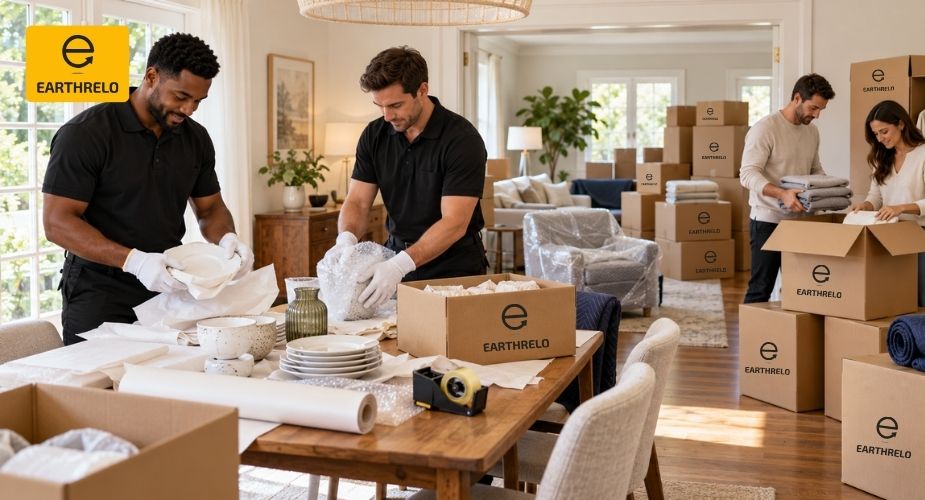
Plates generally need more protection when packed flat with cushioning between them than when placed loosely in a stack. Glassware, ceramics, and electronics should not be allowed to touch one another inside the box.
Label for the First Hour at Your New Home
A useful label answers more than “where does this belong?” Include the destination room, a short description, handling direction if needed, and a box number. Color-coding can help, but written labels remain important when lighting is poor or several people are unloading.
Put an “open first” marker on a limited number of boxes containing practical arrival-day supplies.
To put packing tips for moving into practice, remember that these might include basic cookware, coffee or tea supplies, towels, toiletries, bedding, chargers, cleaning items, and a small amount of clothing. Do not label half the shipment this way; too many priority boxes eliminate the benefit.
For furniture and larger pieces, photograph cable connections, drawer contents, and hardware locations before disassembly. Place screws and fittings in a sealed bag, label the bag by furniture name, and attach it securely to the corresponding piece when practical.
Keep a second record in case the hardware becomes separated. One of the simplest packing tips for moving is to label boxes for their destination.
Use Extra Care for Kitchens, Electronics, and Artwork
Kitchens often take longer than expected because they contain many small, irregular, breakable, and heavy items.
Begin with serving pieces and specialty tools, then move toward everyday dishes and equipment. Protect appliance doors, sharp edges, and removable components so they do not damage other contents.
Electronics should be clean, dry, and protected from impact. Photograph the back of complicated setups, keep cables together, and label each group. If original packaging is available and still in good condition, it may provide useful protection; otherwise, use suitable cushioning and a box that does not allow movement.
When applying packing tips for moving, remember that artwork, mirrors, framed photographs, and glass tabletops require more than a “fragile” sticker. Their size, weight, frame construction, and glass surface affect the protection method.
Some pieces may be suitable for standard professional packing, while unusually valuable or delicate work may justify custom crating. Discuss those items before packing day rather than presenting them as a surprise at the door.
Know When Professional Packing Is the Better Choice
Among practical packing tips for moving, packing yourself can provide control and may work well when you have time, standard household goods, and a manageable shipment.
Professional packing can be valuable when the move is large, the schedule is tight, the household includes many fragile items, or work and family demands leave little time for preparation.
A useful compromise is partial packing. You may pack clothing, books, and low-risk items yourself while requesting professional assistance for the kitchen, artwork, antiques, electronics, or large quantities of fragile goods.
Confirm what the quoted service includes, including materials, labor, unpacking, debris removal, and any exclusions. Clear scope matters more than choosing the lowest headline price.

Have questions about your upcoming move?
Our team is ready to help.
Coordinate Moving Day, Transportation, and Arrival Without Confusion
With useful packing tips for moving, packing does not end when the last box is sealed. Loading order, access conditions, communication, and arrival planning all affect whether the move feels controlled.
A household can be perfectly packed and still experience delays if the crew cannot reach the home, the building has unconfirmed access arrangements, or essential items are mixed into the shipment.
Prepare the Home for the Crew
Before loading begins, clear walkways and identify items that are not moving. Protect the areas that need protection according to the home’s condition and access route, and keep children and pets away from active loading areas.
If elevators, loading docks, parking spaces, building reservations, or narrow access points are relevant, communicate those details as early as possible. Reliable packing tips for moving should also address fragile and valuable items.
Walk through the home with the crew lead before work starts. Point out fragile pieces, items requiring disassembly, packed boxes that should not be loaded, and belongings that will travel separately. This short conversation can prevent assumptions that are difficult to correct once the truck is full.
Among practical packing tips for moving, keep your inventory, estimate, contact information, keys, and personal essentials accessible. Do not pack them in a box that will be loaded early.
If the move involves storage or multiple delivery stages, mark which items belong to each destination and confirm how they will be identified.
Review the Quote for Scope, Not Just Price
When comparing moving estimates, look beyond the total figure. Check whether the quote reflects the current shipment size, packing labor, materials, stairs, long carries, disassembly, reassembly, storage, vehicle shipping if applicable, and any special handling.
The right comparison is between equivalent scopes of work. When using packing tips for moving, confirm which packing tasks your movers cover.
Ask what circumstances could change the amount. Examples may include a larger shipment than described, additional packing, difficult access, waiting time, added storage, changes in origin or destination conditions, or services requested after booking.
These factors do not automatically mean a company is acting improperly; they show why the original scope should be specific and updated when circumstances change.
For anyone researching an overseas moving company, the same principle applies with additional planning complexity. Route, shipment volume, packing standards, documentation, delivery conditions, and destination coordination can affect the plan. When using packing tips for moving, confirm which packing tasks your movers cover.
Confirm the service scope in writing and ask which parts of the process are included, which are handled by partners, and which customer decisions could affect cost or timing.
Protect the First 24 Hours After Delivery
At the destination, direct boxes to their intended rooms instead of creating one large pile. Keep the inventory available and check visible condition concerns as the shipment is unloaded.
Do not rush to unpack every carton; first make sure essentials, furniture placement, and any items needing immediate attention are identified. One of the simplest packing tips for moving is to label boxes for their destination.
Create an arrival kit containing basic tools, cleaning supplies, chargers, towels, bedding, snacks, water, and medications. If you have children, pets, or an early work commitment, plan their first-night needs separately. This small amount of preparation prevents a common mistake: opening random boxes simply to find basic supplies.
If something appears missing or damaged, document it promptly and follow the carrier’s claim or issue-reporting process. Keep photographs, box labels, inventory notes, and relevant move documents together. The exact process can depend on the service and shipment, so review the applicable paperwork rather than relying on memory.
Wrapping Up
The most effective packing tips for moving are not about packing faster. They are about making fewer rushed decisions, moving only what is worth transporting, protecting items according to their real risk, and keeping the shipment clearly organized from the first box through delivery.
Among practical packing tips for moving, begin with a realistic schedule and a room-by-room inventory. Declutter before buying large quantities of supplies.
Use containers that match the weight of their contents, label every box for the room where it belongs, and separate personal essentials from the shipment. For fragile, valuable, unusually large, or time-sensitive belongings, decide early whether professional packing or specialized handling makes more sense.
When you request residential moving services, provide an accurate description of the household and ask questions about scope, access, packing, storage, special handling, and possible cost changes.
At Earthrelo, customers can use that information to have a more practical conversation about their moving and packing advice, shipment needs, and service options. Reliable packing tips for moving should also address fragile and valuable items.
A clear plan will not remove every moving-day variable, but it can prevent the avoidable chaos that makes a household move feel harder and more expensive than necessary.